environment

we lead the way in cutting emissions and creating cleaner travel
Here at Transdev, we’re on a journey to provide greener and cleaner travel solutions at the heart of everyday life in Yorkshire and Lancashire.
A switch to a revolutionary high-blend biodiesel fuel helped us to cut our carbon dioxide emissions by thousands of tonnes in only seven months, thanks to our partnership with fuel provider Argent Fuels.
In November 2023, we successfully switched our entire diesel powered bus fleet across Yorkshire and Lancashire to high blend biodiesel fuel, saving 3,054 tonnes of CO2 emissions in the seven months from April to October 2023 – equivalent to taking 455 cars off the North’s roads.
Transdev pioneered zero emission electric buses on local routes in Harrogate several years earlier, in summer 2018 – but that was only the beginning of our electrifying story.
Years of hard work went into creating a bigger, better battery-electric bus for a new generation. We trialled different types of electric bus and asked our customers to tell us which they preferred – and why.
Our engineers put considerable thought and effort into developing a bus capable of all-day running on our flagship Yorkshire route, The 36, linking Harrogate with Leeds and Ripon.
With most buses covering over 100,000 kilometres, or 62,100 miles, a year with two million customer journeys per annum, we needed a bus custom engineered to deliver a positive step change in performance alongside all the environmental benefits of electric power.
We formed close partnerships with our chosen vehicle manufacturer, UK-based Alexander Dennis, working together to take our best ideas from the drawing board to the road.
A successful funding application to underpin Transdev’s own investment in the project was made through ZEBRA, the Government’s Zero Emission Bus Regional Areas fund, with support from partner North Yorkshire Council.
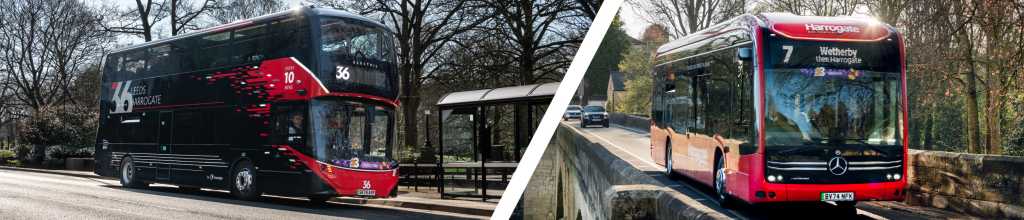
On a sunny June day in 2024, the atmosphere was suitably electric outside Harrogate landmark luxury hotel The Yorkshire, as the wraps came off our very first all new zero emission double deck bus for The 36.
Our invited guests joined us for a VIP reception in the build-up to the unveiling of bus number 2201, our first of 19 Alexander Dennis Enviro 400EV vehicles in a stunning red, black and silver livery guaranteed to turn heads.
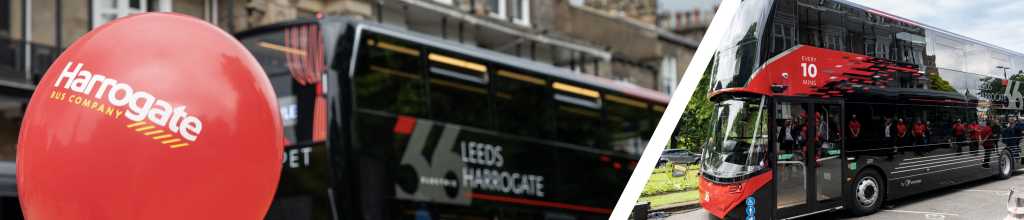
On the outside, our Enviro 400EVs are packed with safety features, including digital electronic rear view cameras in place of the traditional mirrors, giving drivers a clearer view of potential hazards.
Meanwhile on the inside, a glazed staircase leads to two-plus-one seating on the upper deck, with glazed roof panels to let in natural light and wireless mobile device charging – and on the lower deck, two dedicated wheelchair spaces and high-visibility flooring and lighting make travel easier and safer for all our customers.
Also on show was a demonstration vehicle to give our customers a foretaste of our next generation single deck bus, the Mercedes-Benz eCitaro.
The first of our fleet of 20 fully electric eCitaros entered service in November 2024 on our intensive Route 1 between Harrogate and Knaresborough – just days after we celebrated winning the prestigious Environment Award at the bus industry’s UK-wide Route One Awards.
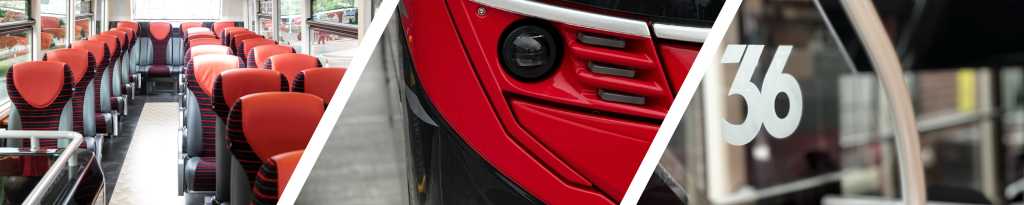
A total of 39 double and single deck vehicles have since transformed our Harrogate area routes, supported by a parallel programme to re-equip our Harrogate depot to provide up-to-the-minute electric charging and maintenance services – on top of additional charging facilities in place at Harrogate Bus Station.
At The Harrogate Bus Company, our buses cover a mileage of approximately four million kilometres per year.
A typical diesel bus produces 1.3 kg of carbon dioxide (Co2) per kilometre travelled (data source: https://www.carbonindependent.org/20.html) – meaning our former Harrogate diesel fleet emitted around 5.2 million tonnes of Co2 per annum.
These emissions have been cut by 99 percent now that most scheduled Harrogate bus journeys are operated by electric or hybrid buses – creating a blueprint for green transformation which we intend to roll out more widely across our networks in the North of England.
For the few remaining diesel buses retained to cover Harrogate school contract work, our switch to biodiesel is also reducing emissions by up to 90 percent, in line with supplier Argent Fuels’ predictions. Based on school buses covering 60k miles per annum, this delivers a considerable reduction in Co2 emissions from 78,000 kgs to less than 10,000 kgs per annum (data source: https://www.argentfuels.com/news/transdev-biodiesel-partnership/).
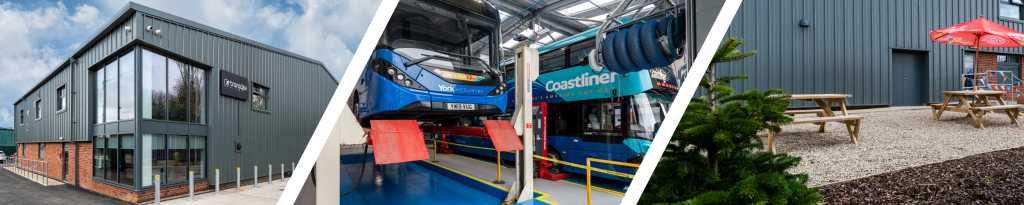
Elsewhere, our new green depot in York opened its doors for the first time in March 2024, providing a reduction in carbon emissions of 28%, compared with the statutory level set by Government in 2013.
This was achieved through detailed design integration of renewable technologies, such as solar panels, air source heat pumps, building airtightness and associated detail measures, to create an energy efficient and sustainable building.
Biodiversity is also enhanced by planting, plus bird and bat nesting boxes to support the natural environment around the depot site. Charging facilities for light electric vehicles are included, while the new building in York has been prepared for future full electrification of its bus fleet.
The York depot features an engineering workshop filled with the most up-to-date hardware, including high-tech vehicle lifting gear and diagnostic performance testing equipment – while behind the scenes, staff welfare and office accommodation also benefit from the latest energy-saving, emission-reducing technology.
Our York & Country buses are stabled and maintained at the new facility at Rawcliffe in the north of the city, plus a small number of vehicles for our Coastlinerroute linking York with Leeds and the Yorkshire Coast – joined by bright red open top buses from our CitySightseeing York tours operation. The new depot has created a superb facility for our teams on the road and in the workshops, and a springboard for future transition of our York fleet to hybrid and zero emission electric power.
As soon as York’s new green depot opened, we turned our attention to West Yorkshire. Within a month, in June 2024 we placed an order worth £4 million for 15 Mercedes-Benz Citaro Hybrid single deckers for our FLYER network linking Bradford, Leeds, Otley and Harrogate with Leeds Bradford Airport.
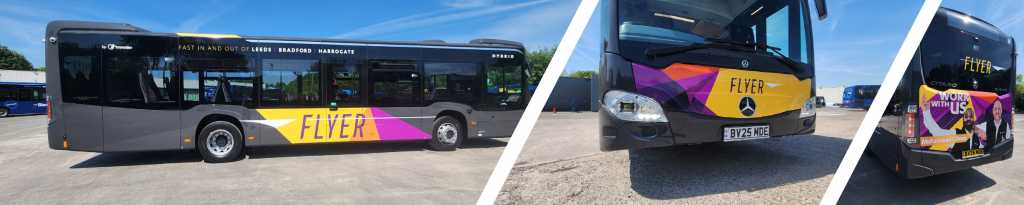
These impressive vehicles run on a combination of electric power and biodiesel to keep emissions as low as possible with a hybrid design.
Beneath their outer shell is a design filled with innovative features, including regenerative braking which uses ‘self-charging’ technology to feed the on-board 14 kW electric motor which in turn supports the low-emission diesel engine.
Roof mounted batteries store energy which also powers the electric motor – and when power from the engine is required, such as when moving from a standing start or overtaking, the hybrid electric module supports the diesel engine while reducing fuel consumption and lowering emissions.
Engineers at Mercedes-Benz predict that the integration of this cleaner hybrid power solution will deliver an 8.5 percent reduction in fuel consumption, further reducing our total CO2 emissions.
FLYER is delivered in a three-way partnership with the West Yorkshire Combined Authority and Leeds Bradford Airport. Its network of three dedicated routes runs seven days a week, and its new hybrid buses have been well-received by customers heading to the Airport as a welcome greener alternative to driving.
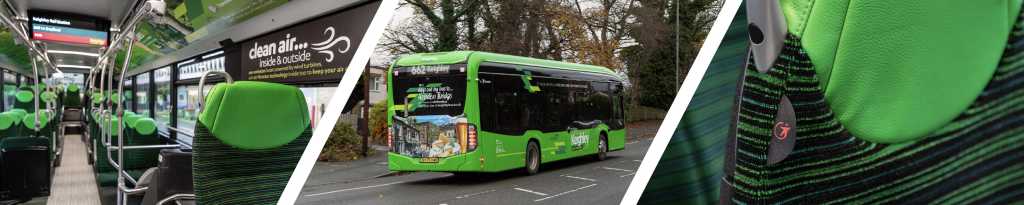
In November 2025, the spotlight turned to The Keighley Bus Company and its two routes linking Keighley with Bradford, the frequent ‘SHUTTLE’ 662 running up to every 15 minutes via Bingley and Saltaire, and the companion route 67 via Cullingworth and Thornton.
The first of our £6.6 million fleet of 15 electric eCitaro buses, resplendent in their eye-catching green livery, took to the road on 6 November – supported by £3 million of Government funding secured by the West Yorkshire Combined Authority from Whitehall’s Zero Emission Bus Regional Areas (ZEBRA) scheme.
The new buses are fully compliant with Bradford’s Clean Air Zone, after it became the first in Yorkshire to introduce the scheme in September 2022, covering all vehicles except private cars and motorcycles.
The switch to electric power on one of the region’s most popular bus routes is expected to further improve air quality on some of Yorkshire’s busiest urban roads.
In each of our operating centres, we’re always looking to make what we do cleaner as well as greener. We now use recycled water to wash our buses, maintaining the high presentation standards we’re famous for while reducing the environmental impact.
Across all our depots in Yorkshire and Lancashire, we will use the considerable experience we’ve gained in recent years to accelerate modal shift from the private car towards our zero emission electric buses – protecting our region’s fragile ecosystems, and making cleaner, greener transport a reality for thousands of our customers, every day.